
The Symptoms No One Connected
The silence around perimenopause is sustained by what research misses, what training skips, what funding overlooks, and what care fails to connect.
If you are a woman somewhere in your forties, some of this may already be happening to you, and no one may have told you why.
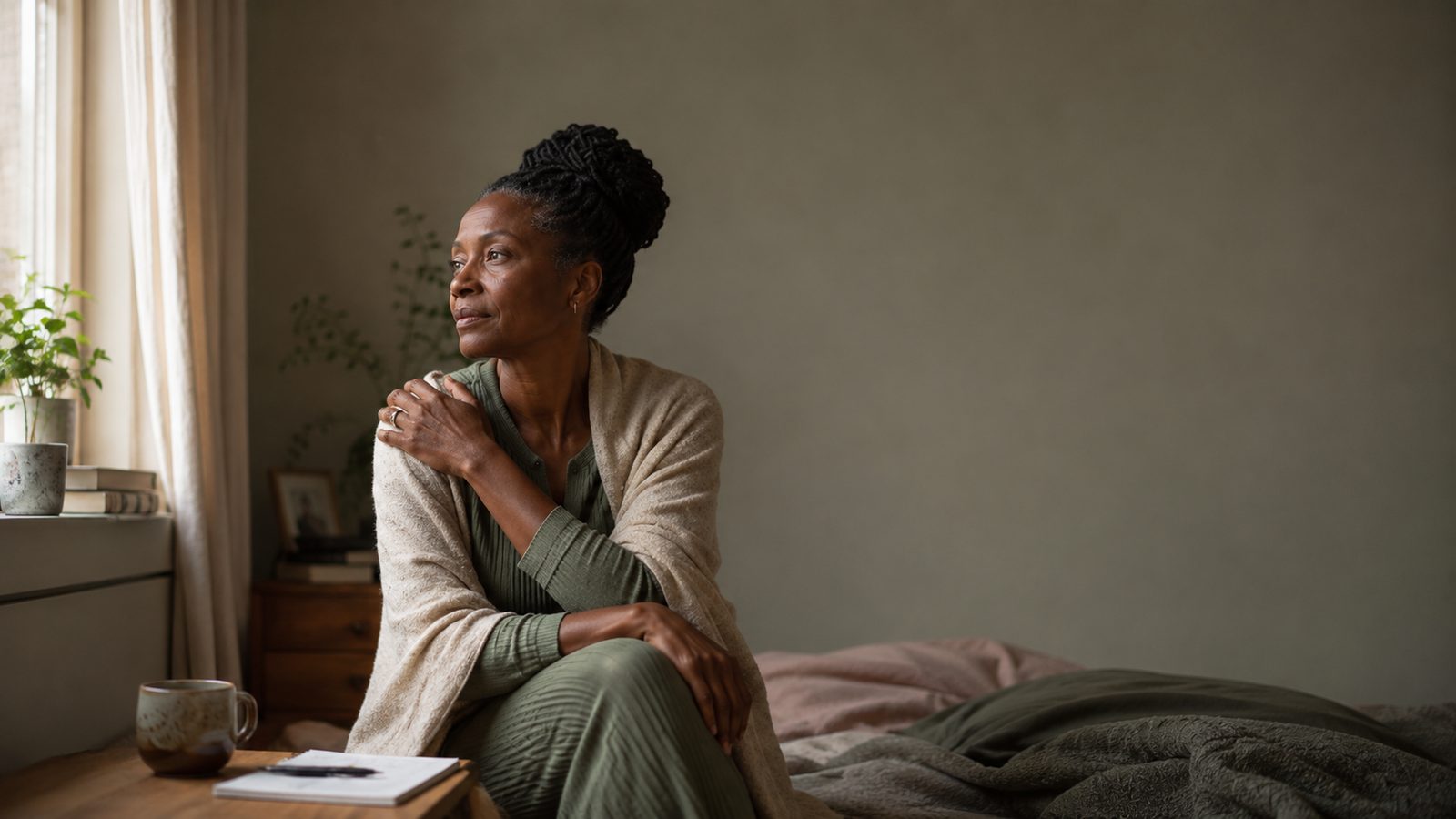
It begins quietly. You wake up one morning and your knees ache, and you cannot think of a single reason why. A few weeks later your shoulder stiffens and you cannot reach the top shelf. You are fine, then you are crying, then you are fine again. You are hot. You are cold. Some nights you wake at three in the morning soaked through, heart racing, and you lie there wondering what is wrong with you. You are tired in a way that sleep does not fix.
You do not connect any of it. Why would you? No one told you these things travel together.
This is perimenopause, the years before the last period, and for many women it stretches close to a decade. Some women are hit hard. Some barely notice the shift. Many feel a version of it and reach for an explanation that has nothing to do with hormones, because that is the only story they were ever handed.
The knee pain may have a name. So may the frozen shoulder. In late 2024 a group of researchers proposed a term for this wider cluster, the musculoskeletal syndrome of menopause. The numbers are not small. Around seven in ten women in the transition report joint and muscle pain, and for roughly a quarter of them it is bad enough to change how they move through an ordinary day. The pain travels, turning up in one joint and then another.
This is one cluster among many. The same hormonal shift can arrive as anxiety, broken sleep, brain fog, a temper that surprises you, heavier bleeding, a body that stops responding the way it used to. Different women meet it through different doors.
What they share is the dismissal. The tests come back clean. The bloodwork looks normal. She is told she is just getting older, or that she should lose some weight, or that it is stress. She goes home with a body that feels ten years past where it was six months ago, and no words to explain it. A normal test result should not end the conversation while the pattern is still speaking.
Here is the part that should unsettle us. That cluster had no name until recently, in a field that has studied women’s bodies for more than a century. Women felt it the whole time. The knowledge had simply not been built, named, or taught with enough seriousness.
Money does more than pay for care. It decides which questions get asked, which symptoms get named, and which women are studied closely enough to be believed.
This is why the news in June mattered. Melinda French Gates put another 215 million dollars into women’s health, and she named midlife and menopause as a clear priority. Her total commitment over two years now sits above 600 million. She has been open about what she is doing. She is sending a signal to other people with money that this is a category worth backing, and that women’s health does not have to remain the thing everyone calls important and too few people fund.
I want to be glad about this, and I am. More money and more attention can move research that should have moved decades ago. The silence has lasted long enough, and the cost of it is finally too visible to ignore.
Then comes the harder question. Where is the signal pointed?
Most of what medicine knows about this transition was learned from women in high-income countries, and mostly from white women. The largest and longest-running study of the menopause transition we have, the Study of Women’s Health Across the Nation, followed women across the United States. It did something rare and worth crediting. It included Black, Hispanic, Chinese, Japanese and white women, and it showed that the experience is not the same across them.
Black women tend to reach menopause earlier, stay in the transition longer, carry heavier and longer-lasting symptoms, and are less likely to be offered treatment for any of it. Researchers have a word for the wear that chronic stress and discrimination put on the body over time. They call it weathering.
Now hold that study next to the woman in Nairobi, Cotonou, Maseru, Bissau or Ndjamena. The evidence that shaped her doctor’s training was not built on her body. The studies that exist on African women are comparatively few, scattered and small. Those few studies suggest that some women may reach menopause earlier than the textbook age of fifty-one, often somewhere in their late forties, with their own pattern of symptoms. We are mostly guessing.
Her clinician, if she has one, likely trained on material that rarely covered menopause in any depth. She arrives with knees that ache and nights that burn, and the system meets her with a shrug shaped by data that rarely included women like her.
I keep returning to the same thought across this series. The failure here belongs to no single person. Researchers studied the bodies that were easiest to reach. Medical training left a gap and never closed it. Health systems built around acute illness kept little room for a slow transition. Funding followed attention, and attention was elsewhere. Women, taught that this was private and a little shameful, kept the silence with one another. All of us could have done better. All of us still can.
Talk about it. Name the knee pain to your sister, your friend, your doctor. Ask whether what you are feeling could be part of the transition, and keep asking if the first answer is that you are simply getting older.
Clinicians can read the pattern even when the test result reads normal. Funders can send the new money toward the women who have been counted least. Researchers can build evidence that finally includes the woman in Nairobi, Cotonou, Maseru, Bissau and Ndjamena.
The woman in Maseru deserves to be counted inside the evidence. Right now she is spoken for by data built on other women.
This phase was always going to come. The silence around it did not have to.


Endometriosis: What Happens After Women Are Finally Believed
Part two of a series on the conditions women are taught to carry quietly
Last week I wrote about adenomyosis, the condition that hides because almost no one gives it a name. Endometriosis is different. Many people have heard of it. It has an awareness month, foundations, research centres, and women with large platforms who speak about it openly. The usual story is that women are not believed, and in many cases that is true. But disbelief is not the only failure. Pain is also minimized, normalized, misread, or treated as something a woman must simply learn to manage. I want to follow the story further than recognition.
Endometriosis happens when tissue similar to the lining inside the uterus grows outside the uterus. It can be found on the ovaries, fallopian tubes, bowel, bladder, and other parts of the pelvis. In some cases, it is found beyond the pelvis. This tissue responds to hormonal changes, which means it can swell, bleed, and trigger inflammation. Because it is outside the uterus, the body cannot shed it in the same way it sheds a period. Over time, this can lead to pain, scarring, and organs sticking to each other. For some women, the pain starts around their period. For others, it becomes pain that follows them through the month, affecting sex, bowel movements, urination, fertility, work, school, and daily life. Roughly one in ten women and girls of reproductive age live with endometriosis, about 190 million people globally.
The part that holds my attention as a practitioner is not only the seven to ten years that often pass before diagnosis, long as those years are. It is what we hand a woman once the name finally arrives. The options on offer can help and often do. Hormonal therapy, which uses medicines such as contraceptive pills, injections, implants, or other hormone-regulating drugs, can reduce bleeding, slow the activity of endometriosis tissue, and quiet pain for many women. Excision surgery, where a trained surgeon cuts out endometriosis lesions rather than simply burning the surface, can bring real relief when it is available and done well. Pain management, pelvic floor therapy, and fertility support each have their place when a woman can reach them.
The problem is rarely any single one of these options. The problem is that they often arrive as a narrow menu rather than a pathway built around a life. Too often, a woman is left to navigate that menu largely alone: manage symptoms, weigh surgery, watch for recurrence, protect her fertility if she still can, and keep rebuilding her days around a condition no one has fully designed care around. There is no cure at the end of it, which makes the shape of the care matter all the more.
The issue is not that these options have no value. Many women need them, and many women benefit from them. The issue is that care is still too often organized around the disease rather than the woman living with it. It is built around the lesion, the bleeding, the scan, the prescription, the surgery, and the next appointment. It is less often built around the child she may want, the job she cannot keep losing days from, the relationship under strain, the school she is missing, or the ordinary Tuesday she would like to live without counting the hours.
That is a design failure, and design failures have design answers. This is where the conversation usually stops. It is where I think it should start.
People-centred care appears in many health strategies, but too often it disappears at the point where women need it most: diagnosis, treatment choices, pain management, fertility decisions, and long-term support. Human-centred design would begin with the woman’s own definition of a good outcome, not only the clinicians. Social and behaviour change would reach the silence that keeps her from naming the pain at all, long before she ever sits in a clinic. Public health already has these disciplines. The question is why we have not applied them, with enough seriousness, to conditions like this.
I keep returning to the question I asked last week. Who failed them? This week I want to be more precise about where the weight falls. The burden is the woman’s, and that much is visible in any waiting room. The responsibility sits heaviest with the people who design care without her in the room: the ones who set the research budgets, who decide what counts as a treatment, and who decide what counts as success. The researcher, the clinician, the policymaker, the company, and the community all hold a share. The largest share belongs to whoever holds the pen when the system is drawn, because that is the moment a woman’s life is either kept in view or left out of the picture.
The gap widens across many African settings. For decades, endometriosis was framed in medical literature as a condition more commonly seen among white, affluent women, and by inference, rare among Black women and women of African descent. That framing was not supported by evidence. It was shaped by who had access to diagnosis, specialist care, and surgical facilities, and by whose pain was taken seriously. A 2022 paper in Reproduction and Fertility documented how this misconception has directly contributed to long diagnostic delays, limited access to care, and a stark scarcity of research on endometriosis among African women. That history still has a clinical life. It shapes what is suspected, what is investigated, and how urgently pain is treated. In Uganda, a 2025 audit found that just four specialists remain to manage the condition across the entire country. Laparoscopic surgery, the most reliable diagnostic pathway, costs more than most families can afford. Specialist consultation is concentrated in urban centres and largely inaccessible through routine public services. A condition that is already hard to diagnose and treat becomes, here, one that many women may never get the chance to have properly named, let alone managed with care.
Recent clinical guidance has begun to shift away from making surgery the price of a diagnosis. The 2022 guideline from the European Society of Human Reproduction and Embryology supports diagnosis based on symptoms, examination, and imaging where appropriate, rather than requiring every woman to undergo laparoscopy before her care begins. The American College of Obstetricians and Gynecologists moved in the same direction with new guidance in early 2026. This matters, because it means a woman’s account of her own body is finally being taken more seriously. It also fixes the front door while leaving much of the room unchanged. The treatments available today are still largely the same one’s women were offered a generation ago.
I am staying with this series because the questions carry from one condition to the next. What did we know? Who should have acted? What do we owe the person living inside this body? Adenomyosis asked us to see what hides. Endometriosis asks us to look hard at what we offer once we have seen, and to admit that recognition without a better answer is only half a kindness. Perimenopause is next, and the same question waits there.
Over the coming weeks, I will sit with these questions. I hope you will sit with them too, not only as readers, but as practitioners, funders, researchers, policymakers, and women who know that being believed should be the beginning of care, not the end of it.
If you are working on women’s health, public health systems, care pathways, research, or community-centred programming, we would be glad to connect. Orpesi Collective supports partners to design approaches that begin with people’s lived realities and move toward practical, lasting change.
Reach us at info@orpesicollective.org.

Adenomyosis: The Condition Too Many Women Suffer Through Before It Is Named
I am a public health practitioner working in women’s health. I am also a woman. Those two facts sit in the same body, and they do not always agree with each other.
When I visit my gynaecologist, I rarely leave on time. I ask too many questions. I follow the answers into places most appointments do not have room for. Part of that is temperament. Most of it is what I carry from working in this field, where I have watched women describe pain that the system has trained itself not to hear.
Adenomyosis is one of those places the conversation rarely reaches.
Say the word out loud and watch what happens. People pause. They ask you to repeat it. Many have heard of endometriosis, and a few can describe it. Adenomyosis lands as something new, even among women who have lived with its symptoms for years. That gap between how common the symptoms can be and how rarely the condition is named carries the whole story.
Let me explain it plainly. Adenomyosis happens when tissue similar to the lining of the uterus grows into the muscular wall of the uterus itself. It can cause heavy bleeding, deep menstrual pain, chronic pelvic pain, an enlarged uterus, and exhaustion that many women carry while being told their periods are simply difficult. Some women may also experience fertility challenges, while others may have few or no symptoms at all. That variation is part of what makes the condition so easy to miss.
Here is what unsettles me as a practitioner. Adenomyosis has been recognized in medical literature for more than a century, yet for much of that time, the most certain diagnosis came only after hysterectomy, when the uterus could be examined directly. Think about what that means. For generations, the clearest confirmation often came after a woman had already lost the organ at the centre of the pain. Imaging has shifted the standard of practice. Transvaginal ultrasound and MRI can now support diagnosis without surgery, but they offer probability, not certainty, and only when the tools are available, the signs are recognized, and the person interpreting the results knows what to look for. In many health systems across Africa and beyond, that level of access still sits far out of reach.
Women wait, and the waiting compounds. They are told their pain is normal. They adjust their lives around it. They learn to plan their months around bleeding they cannot predict. Years pass before anyone names the condition, and a good deal of trust has been spent along the way.
I keep returning to one question. Who failed them?
The honest answer is that the failure is shared, and it runs through every level of the system. Research and funding decided long ago that this pain sat low on the list, and the science moved too slowly. Medical training has not equipped enough clinicians to recognize the condition early or to hold the conversation with care. Health systems offer no clear pathway, and they rarely measure whether a woman’s quality of life improves. Industry has too often followed the treatments that are easiest to package, rather than the care pathways women need across their reproductive lives. Families and communities’ taught generations of girls that suffering quietly was a form of strength.
Women themselves learned to doubt their own bodies. That last part is the one I want to handle gently, because it is real, and it carries no blame. You cannot name what no one gave you the words for.
This is why I think of it as a shared responsibility. The researcher, the clinician, the policymaker, the company, the community, and the woman who has been taught to wait each sit somewhere in this story. No single villain stands at the centre of it. A web of small refusals to act adds up to one woman in a waiting room, wondering whether she is imagining her own pain.
I am starting this series with adenomyosis for that reason. If we can learn to see the condition that hides best, we may also learn to see the systems that keep women’s pain unnamed for too long.
Endometriosis and perimenopause follow, and the same questions will travel with them. What did we know? Who should have acted? What do we owe the person living inside this body?
Over the coming weeks in June, I will sit with those questions. I hope you will sit with them too, not as observers, but as people who are part of the answer.